
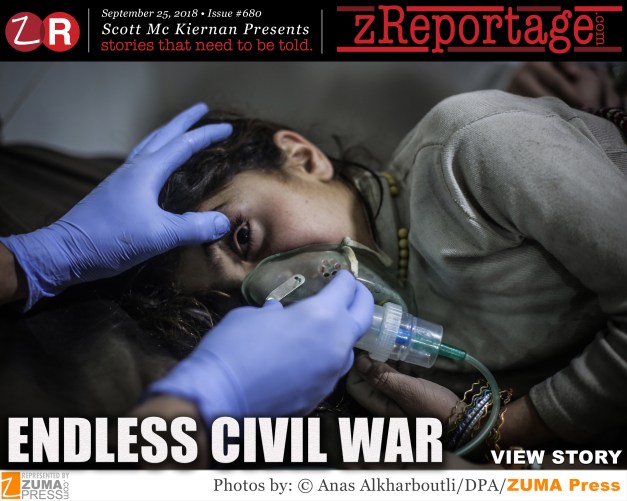
Since the conflict erupted in March 2011, Syria has witnessed unprecedented devastation and displacement. More than 5 million Syrians have fled the country and 6 million are internally displaced. In July, the civilian population in Idleb, particularly women and children, continued to be severely impacted by insecurity due to fighting between armed groups. Abduction of civilians, assassinations, increased violence against medical workers and injuries due to vehicle-borne improvised explosive devises (IED’s) were reported across the region. Aerial bombardments across Idlib and western Aleppo continued to result in causalities and injuries among children. Staffan de Mistura, the UN Special Envoy for Syria stated recently, ‘If we see a Ghouta scenario in Idlib, this could be six times worse, affecting 2.3 million people.’ Eastern Ghouta was the rebels’ major stronghold within striking distance of the capital. Rebel attacks launched from the area made reclaiming it a priority for the Syrian regime. A chemical attack on Ghouta in 2013 killed 1,429 people, including 426 children. The attack earlier this year is alleged to have killed almost 2,000 people, the majority civilians, including 371 children, according to the Syrian Observatory for Human Rights. ‘A full scale battle for Idlib must be avoided at all costs’, United Nations Secretary-General Antonio Guterres has stressed, warning that failure to do so would unleash ‘a humanitarian nightmare unlike any seen in the blood-soaked Syrian conflict’ so far. More than 13 million people inside Syria require humanitarian assistance, including nearly 6 million children. At the end of 2017, more than half the country’s hospitals, clinics and primary health care centers were only partially functioning or had been damaged beyond repair. War crimes investigators and activists have amassed an ‘overwhelming volume’ of testimony, images and videos documenting atrocities committed by all sides during Syria’s war, a U.N. quasi-prosecutorial body said in its first report. The U.N. team said its work would proceed independently of any Syrian peace process and be based on the principle that no amnesty can be granted for ‘core international crimes.’
 ZUMAland.com