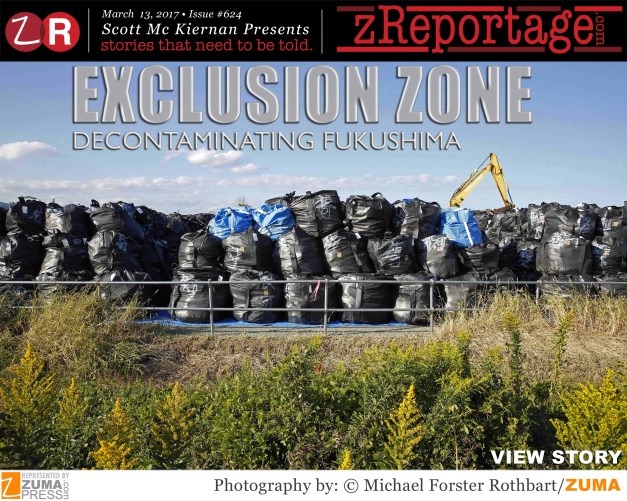
Decontaminating Fukushima – Launched March 13, 2017 – Full multimedia experience: audio, stills, text and or video: Go to zReportage.com to see more – In March 2011, an earthquake and tsunami hit northern Japan and destroyed the Fukushima Daiichi nuclear power plant. Some 488 thousand people evacuated from Fukushima Prefecture after the three-part disaster, in 2017, nearly 25% remain displaced. A massive effort is now underway to decontaminate towns in the Fukushima Exclusion Zone. Thousands of laborers are cleaning or demolishing every building, and removing and incinerating all topsoil in inhabited areas. In the adjacent forests and mountains, radiation levels remain higher and will not be cleaned. Naraha, 12 miles south of the nuclear plant, was the first closed town to reopen after the disaster. Residents were allowed to return home full-time on Sept. 5, 2015. To date, an estimated 800 residents have returned, out of a pre-disaster population of 7,400. In March and April 2017, four more towns, Namie, Kawamata, Iitate and Tomioka will allow residents to return. Some areas closest to Fukushima Daiichi are too radioactive and may never reopen. Michael Forster Rothbart’s reportage in Fukushima was funded by grants from NPPA and the International Center for Journalists.

Story link:
http://joeland7.blogspot.com/2009/03/tony-bohler-son-of-jfk-origin-of-aids.html
ASAP Please FTP your pictures as usual, then email Licensing@zumapress.com to let us know!
Thanks, Katrina
Story link: https://en.wikipedia.org/wiki/Anne_Carson
ASAP Please FTP your pictures as usual, then email Licensing@zumapress.com to let us know!
Thanks, Katrina
ZUMA client looking for pictures of The Ajin factory and Matsu Alabama Inc (any coverage)
Please FTP your pictures as usual, then email Licensing@zumapress.com by Friday Thanks, Katrina
ASAP Please FTP your pictures as usual, then email Licensing@zumapress.com to let us know!
Thanks, Katrina
Story link: http://www.newyorker.com/magazine/2017/03/13/donald-trumps-worst-deal
https://en.wikipedia.org/wiki/Ziya_Mammadov
ASAP Please FTP your pictures as usual, then email Licensing@zumapress.com to let us know!
Thanks, Katrina
Story link: http://www.smninews.com/tag/jose-e-b-antonio/
ASAP Please FTP your pictures as usual, then email Licensing@zumapress.com to let us know!
Thanks, Katrina
Story link : https://thewest.com.au/business/agriculture/chinese-set-to-enter-aussie-live-export-trade-ng-b88373143z
ASAP Please FTP your pictures as usual, then email Licensing@zumapress.com to let us know!
Thanks, Katrina
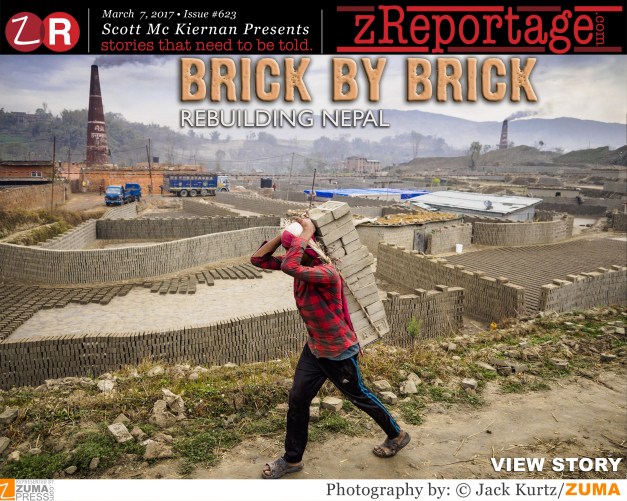
On April 25, 2015, a 7.8-magnitude earthquake struck Nepal. Two weeks later, a second one hit. Almost 9,000 people were killed and over 22,000 injured. More than 80% of Nepal’s population lives in rural areas, most in homes made of stone, mud, and thatch. Some 3 million people, including women and children were displaced and an estimated 800,000 buildings are destroyed or severely damaged. The earthquake impacted the livelihoods of 2.3 million households and 5.6 million workers, and up to 90 percent of enterprises in the worst-hit districts. Migrant workers in some 50 brick factories near Bagmati in central Nepal are working overtime producing bricks for the reconstruction effort in Kathmandu, Bhaktapur and other cities in the Kathmandu valley that were badly damaged by the 2015 quake The kilns have been in the Bagmati area for centuries because of the high quality local clay, a popular raw material for the bricks. The kilns have a rectangular brick wall the size of a football field, with a tall chimney at its center. Workers pile raw bricks in rows inside the kiln prior to covering them with a layer of dirt. The kilns burn at up to 1,800 degrees Fahrenheit continuously for the brick production season, which lasts almost the entire winter. The brick makers of Nepal, will be busy for years to come supplying the raw materials for this huge reconstruction project.